Nigeria’s leading traditional rulers, pharmaceutical industry leaders, regulators, and policymakers have called for urgent, coordinated action to rebuild the country’s pharmaceutical industry and reposition it as a pillar of national health security, economic resilience, and industrial sovereignty.
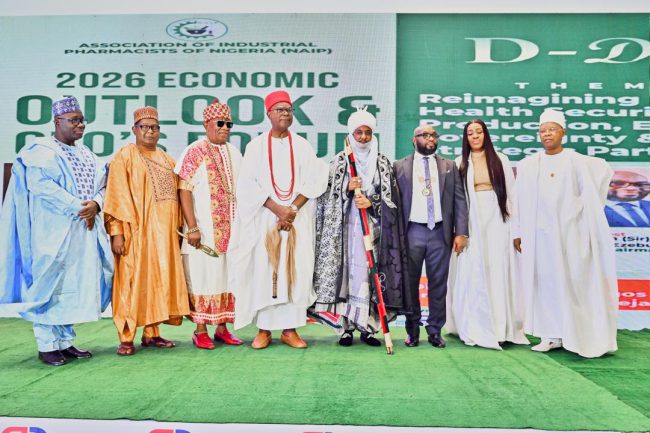
The call was made at the 2026 Economic Outlook and CEOs Forum of the Association of Industrial Pharmacists of Nigeria (NAIP) held in Lagos, where stakeholders converged under the theme, “Reimagining Nigeria’s Health Security: Local Production, Economic Sovereignty and Strategic Partnerships.”
The forum brought together an unusually broad coalition of authority and expertise, including the Emir of Kano, His Royal Highness Mallam Muhammadu Sanusi II (CON, PhD); the Obi of Onitsha, His Royal Majesty Igwe Nnaemeka Alfred Achebe; the Ezechuamugha and Igwe of Ogidi Kingdom, Pharm. Alex Onyido; and the former Minister of Health and Chairman of Our Lord Pharmaceuticals, Prince Julius Adelusi-Adeluyi. Also present were senior regulators, industry captains, past presidents of the Pharmaceutical Society of Nigeria (PSN), and chief executives across the pharmaceutical value chain.

Delivering the keynote address, Emir Sanusi framed the pharmaceutical challenge as a structural one that goes beyond access to finance. He argued that poor coordination across policy, regulation, infrastructure, and production has left Nigeria’s pharmaceutical sector weak and excessively dependent on imports. He noted that about 70 per cent of medicines consumed in Nigeria are imported, with over 80 per cent of those imports coming from a single foreign source, a concentration he described as a serious vulnerability for a nation of more than 200 million people.
According to him, this dependence exposes Nigeria to supply disruptions, price shocks, and external policy decisions, while denying the economy jobs, skills, and value addition. Nigeria’s large domestic market, he argued, should be leveraged to attract manufacturing investment rather than sustain import-driven consumption. He identified inefficient port operations, overlapping regulatory agencies, high energy costs, fragile logistics networks, and prolonged clearance delays as key obstacles confronting manufacturers.
Sanusi also lamented weak collaboration between research institutions and industry, noting that innovations developed in universities and research centres rarely progress to commercial production because of regulatory and administrative barriers. He said Nigeria is yet to build meaningful capacity in active pharmaceutical ingredients, vaccines, diagnostics, and essential medical equipment, leaving the country overly dependent on external suppliers even for basic health needs. While acknowledging infrastructure constraints, he stressed that health security is inseparable from national security and requires deliberate political engagement.
Following the keynote address, the National Chairman of NAIP, Pharm. Bankole Aminu Ezebuilo (FPSN), anchored the core policy discussion of the forum. He said the theme of the event was not ceremonial but strategic, describing medicines, vaccines, and diagnostics as strategic national assets rather than ordinary commodities. Drawing lessons from the COVID-19 pandemic, supply chain disruptions, and currency volatility, Ezebuilo said no serious nation outsources its survival plan and warned that Nigeria must move decisively from consumption to production.
He called on the Federal Government to designate pharmaceutical and medical manufacturing as critical national infrastructure and to support the sector through targeted incentives, including tax relief, import-duty waivers on inputs, subsidised energy, and concessional financing. He also urged government to use public procurement strategically to guarantee demand for locally produced medicines, ensure prompt payment to suppliers, and integrate pharmaceutical manufacturing into national industrial and economic planning.
Addressing the challenge of financing, Ezebuilo said the sector requires patient capital, long-tenor funding, blended-finance structures, and credit-enhancement instruments capable of de-risking investments across the pharmaceutical value chain. He stressed that short-term working capital cannot build an industry and advocated backward integration into raw materials and packaging, stronger regulatory capacity, investment in biotechnology, and deliberate skills development to support sustainable growth.
In his remarks, the President of the Pharmaceutical Society of Nigeria (PSN), Pharm. Tanko Ayuba, commended NAIP for driving the industrial agenda and urged government and stakeholders to play their respective roles in strengthening the sector. He said the pharmaceutical industry has the potential to contribute far more to Nigeria’s gross domestic product if supported by stable policies, adequate infrastructure, and access to finance. According to him, collaboration among professional bodies, regulators, manufacturers, and investors is essential if Nigeria is to compete effectively within ECOWAS and under the African Continental Free Trade Area.
Earlier, the Father of the Day at the event, Prince Julius Adelusi-Adeluyi, challenged pharmacists to reposition themselves as central actors in healthcare delivery, industrial development, and public administration. He said the profession possesses a wide range of competencies but has not fully utilised them to influence policy and economic outcomes. Describing medicines as strategic economic assets, he urged pharmacists to embrace leadership, innovation, and governance roles across manufacturing, regulation, and public policy, warning that the profession was punching below its weight.
As Chairman of the forum, the Obi of Onitsha, Igwe Nnaemeka Alfred Achebe, said the theme of the event spoke directly to Nigeria’s present realities and future choices. He warned that excessive dependence on imported medicines, vaccines, and medical devices threatens not only public health but also economic sovereignty and national resilience. According to him, Nigeria has the talent, the market, and the entrepreneurial spirit to transform its health sector, but often lacks alignment of vision, policy consistency, and disciplined execution.
Echoing this position, the Ezechuamugha and Igwe of Ogidi Kingdom, Pharm. Alex Onyido, emphasised the importance of linking research to production. He cited recent initiatives connecting universities with industrial incubation centres and said sustainable pharmaceutical development requires long-term planning, institutional collaboration, and strict adherence to professional standards.
The forum enjoyed strong regulatory and legislative presence, including Hon. Uchenna Harris Okonkwo, Deputy Chairman of the House Committee on NAFDAC; the Registrar of the Pharmacy Council of Nigeria, Pharm. Ibrahim Baba Shehu; and the Director-General of NAFDAC, Prof. Mojisola Adeyeye,.Members of the College of Past Presidents of the Pharmaceutical Society of Nigeria were also present, including Pharm. Dr. U. N. O. Uwaga, Pharm. Anthony Akhimien, Pharm. Azubuike Okwor, Pharm. Olumide Akintayo, and Pharm. Mazi Sam Ohuabunwa.
Past chairmen of NAIP, including Pharm. Ade Popoola, Pharm. Sola Solarin, Pharm. Lolu Ojo, Pharm. Gbenga Folabi, Pharm. I. G. Anukwu, and Pharm. Ken Onuegbu, attended alongside leaders of other professional bodies and manufacturing executives. Industry participation was led by figures such as Dr. Okey Akpa, President of the Federation of Pharmaceutical Employers Associations of Nigeria, and chief executives from leading pharmaceutical companies across the country.
Closing the forum, Ezebuilo said Nigeria can no longer afford to be a spectator in its own health security. He announced that NAIP’s 2026 Annual National Conference will hold in Kwara State in May and urged stakeholders to move from dialogue to implementation. He said that with the backing of the country’s royal fathers, elders, regulators, and industry leaders, excuses had lost their credibility, adding that the time for local pharmaceutical production is not tomorrow, but now.