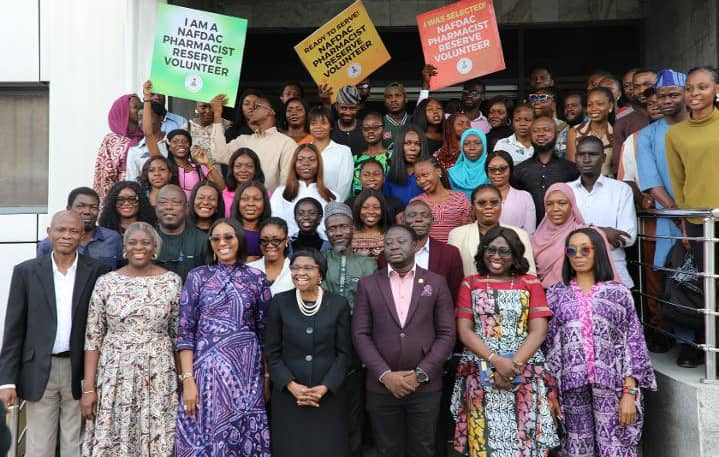
No fewer than 600 pharmacists have volunteered to join the National Agency for Food and Drug Administration and Control (NAFDAC)’s efforts to combat substandard and falsified medicines and unwholesome food, as well as contribute to safety monitoring across the country.
The pharmacists, who are already practising in different fields, were inducted into the agency’s new initiative, the Pharmacists Reserve Volunteer Programme (PRVP), following their selection from the 36 states of the federation and the Federal Capital Territory (FCT).
Speaking at the inauguration of the programme, the Director-General of NAFDAC, Prof Mojisola Adeyeye, said the initiative was part of efforts to strengthen the agency’s regulatory reach and take regulation closer to Nigerians.
Receiving the volunteers and administering the oath of allegiance, Adeyeye charged them to serve the country with integrity, warning that they would encounter offers and pressures aimed at compromising their responsibilities.
“As patriotic Nigerians, I admonish you to reject such offers. The moment a regulator can be bought, the public loses its only protection,” she said. She explained that the 600 pharmacists were drawn from all 36 states and the FCT, representing Nigeria’s six geopolitical zones.
According to her, their selection followed a deliberate and transparent process based on merit, availability and equitable geographical representation.
Adeyeye stressed that the programme was more than an internship or attachment, describing it as an investment in the volunteers and the future of pharmaceutical regulation in Nigeria. “It is an investment in you, and through you, in the regulatory future of this country,” she said.
She said the volunteers would be exposed to key areas of medicines regulation, including pharmacovigilance, compliance monitoring, quality assurance, data collection and public sensitisation against drug abuse.
The NAFDAC boss said the programme was designed to build, over time, a national reserve of trained pharmacists who could be mobilised at short notice during emergencies, product recalls, suspected circulation of falsified medicines and other situations requiring additional regulatory manpower.
She disclosed that her ambition was for every state to have a standing pool of trained, vetted and mobilisable pharmacists who could work alongside NAFDAC state offices. This, she said, would enable the agency’s regulatory presence to extend beyond its laboratories and ports of entry to markets, community pharmacies, patent medicine stores and primary healthcare centres.
“Regulation that lives only in the capital cannot protect a nation of more than 200 million people. This programme is how we take regulation to the doorstep of the Nigerian people,” Adeyeye said. She listed availability, discipline, integrity, confidentiality, continuous learning and respect for communities as key expectations from the volunteers.
“When you are called upon for an assignment, you must respond promptly and ensure that you see it through,” she said. Adeyeye also cautioned the volunteers against disclosing confidential information obtained during inspections and investigations, noting that such information belonged to NAFDAC and the Nigerian people and should not be shared on social media.
She urged them to take their training seriously, ask questions, study relevant guidelines and properly document their work. “You will enter markets, pharmacies and health facilities as ambassadors of NAFDAC and of the pharmacy profession. Conduct yourselves accordingly,” she added.
On the benefits of the programme, Adeyeye said the volunteers would gain practical regulatory experience in areas including pharmacovigilance reporting, laboratory awareness, risk communication and enforcement procedures.
She added that they would be trained and mentored by experienced professionals, while their service would be formally documented through certification and letters of service that could strengthen their professional profiles.
The programme, she noted, would also provide opportunities for the volunteers to build professional networks across the 36 states and the FCT, with experience that could support career advancement in the regulatory and pharmaceutical sectors.
The Coordinator of the PRVP and Director, Narcotics and Controlled Substances (NCS), Dr Rametu Momodu, said the programme had evolved within weeks from a call for expression of interest into a national pool of 600 pharmacists. She explained that the PRVP was designed as an organised reserve system that could provide supplemental support and specific services to NAFDAC during emergencies.
She said the initiative would also promote citizen participation in regulation, post-marketing surveillance and drug demand reduction, particularly through campaigns against drug abuse.
Also speaking, the Coordinator of the NAFDAC Training School, Dr Tunde Sigbeku, said the objective of the training was to equip the volunteers with the knowledge required to support the agency’s regulatory activities. Sigbeku described volunteering as a call to service and responsibility rather than merely a title, stressing that it required devotion and determination.
He said the online training would expose the volunteers to the operations of NAFDAC, including post-marketing surveillance, pharmacovigilance, antimicrobial resistance prevention through the appropriate use of medicines, veterinary medicines in livestock and fish, inspection and enforcement, and narcotics and controlled substances.
“We are going to be diving deep into the menace of drug abuse and its impact on society. You will be a good hand for us in surveillance, intelligence gathering and, above all, research,” he said.
Sigbeku congratulated Adeyeye on the initiative, describing it as the first time NAFDAC would have a national reserve of pharmacists who could serve as additional manpower in its fight against fake and substandard products. He said the volunteers’ knowledge and physical resourcefulness would complement the agency’s existing regulatory capacity and help strengthen its operations across the country.