–As NAPharm inducts 11 new Fellows, honours Emzor boss with Lifetime Achievement Award
The World Health Organisation (WHO) has called on the Federal Government to create an enabling environment for local pharmaceutical manufacturers to thrive as part of efforts to achieve national health security and reduce Nigeria’s dependence on imported medicines.
The global health agency identified reliable electricity supply, access to affordable financing and soft loans, and the availability of essential production materials as critical requirements for boosting local pharmaceutical manufacturing and strengthening the country’s medicine security.
WHO also underscored the importance of innovation, medicine sovereignty and sustainable healthcare, noting that pharmacy practice is strategic to achieving health security and universal health coverage through the local production, regulation, distribution and rational use of medicines and other health products.
WHO Representative and Head of Mission in Nigeria, Dr Pavel Ursu, stated this in his keynote address at the 2026 Annual General Meeting and Investiture of New Fellows of the Nigeria Academy of Pharmacy (NAPharm), held from 16 to 17 November,2026 at the Old Great Hall, College of Medicine, Idi-Araba, Lagos.
Speaking on the theme, “Pharmacy for National Health Security: Advancing Innovation, Medicine Sovereignty and Sustainable Healthcare,” Ursu, who was represented by Dr Akinola Fatiregun, said a nation that could not manufacture, test, regulate and rationally use its essential medicines remained vulnerable to external disruptions.

“A nation that cannot make, test, regulate, and wisely use its own essential medicines is a nation whose health can be switched off from outside itself,” he said.
Reflecting on developments since the COVID-19 pandemic in 2020, the WHO representative highlighted how the crisis exposed the dangers of relying on a handful of companies and countries for the supply of essential medicines and other global public health commodities.
He challenged Nigerian pharmacists to harness their expertise and innovative capacity to develop affordable medicines that would meet the needs of the population.
While acknowledging some progress made by local pharmaceutical manufacturers, Ursu identified several challenges requiring urgent attention, including inadequate electricity supply, weak collaboration between academia and industry, and the need for local manufacturers to secure international prequalification to compete effectively in global markets.
He urged pharmacists in academia to publish research findings in platforms accessible to policymakers and complement their research with sustained advocacy.
Those in the pharmaceutical industry, he said, should pursue internationally recognised quality standards, noting that prequalification and Maturity Level 4 (ML4) status should serve as pathways to global competitiveness rather than mere achievements.
He also called on policymakers to ensure continuity in government policies, sustain incentives for local manufacturers, provide remuneration for pharmacy services and ensure that pharmacists remained actively involved in policy decisions affecting the sector.
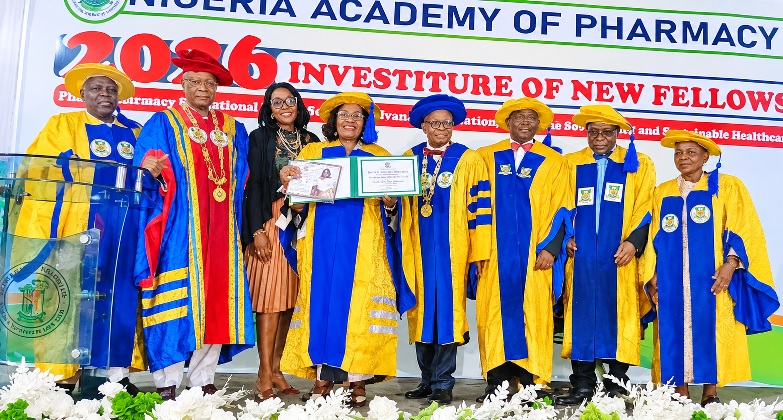
Speaking on the investiture, NAPharm President, Prof. Lere Baale, said the exercise was designed to provide pharmacists with a platform to make significant contributions to the pharmaceutical sector and national development.
He challenged the newly inducted Fellows to deploy their expertise towards transforming the pharmaceutical industry and advancing the nation’s healthcare system.
“Today, you receive more than a title. You inherit an obligation. An obligation to defend scientific integrity, to mentor those coming behind you, to advance knowledge and professional standards, to speak courageously when public health is threatened, and to deploy your expertise in service of our nation and humanity.
“Let your fellowship become a platform for collaboration, mentorship, innovation and service. Do not merely wear this honour of fellowship. Let that honour define your actions,” he charged.
Baale also called on the Federal Government to recognise pharmaceutical development as a strategic national priority by increasing investments in research, innovation, manufacturing excellence and sustainable local production capacity.
Also speaking, NAPharm Vice-President, Pharm. Ahmed Yakasai, said the investiture was an opportunity to celebrate integrity, knowledge and professional excellence among pharmacists.
He explained that the Academy’s selection process went beyond academic and professional achievements to assess the character and integrity of prospective Fellows.
According to him, a screening committee was constituted to evaluate candidates, leading to the selection of 11 pharmacists for the investiture.
Yakasai urged pharmacists to intensify efforts to combat fake and substandard medicines through improved pharmacovigilance, stronger professional standards and greater collaboration across the pharmaceutical supply chain.
The newly inducted Fellows are: Pharm. (Dr) Shakirat Adeosun; Dr Solomon Aigbavboa; Pharm. Ignatius Anukwu; Pharm. (Dr) Josephine Ehimen; Pharm. (Dr) Bankole Ezebuilo; Pharm. Rasheed Faworaja; Pharm. (Dr) Ukamaka Okafor; Prof. Henry Okeri; Prof. Ogboona Okorie; Prof. Ibrahim Oreagba; and Pharm. (Dr) Titilayo Onedo.
In recognition of their contributions to pharmacy and national development, the Academy also honoured distinguished individuals with special awards.
The Chief Executive Officer of Emzor Pharmaceuticals, Pharm. (Dr) Stella Okoli, received the Lifetime Achievement Award in recognition of her contributions to the pharmaceutical industry, including the establishment of a multi-million-dollar Active Pharmaceutical Ingredient (API) manufacturing facility aimed at strengthening Nigeria’s pharmaceutical independence.
Prof. Fola Tayo received the Distinguished Service Award for his contributions to pharmacology and service to the Academy as a foundation member.
The Honorary Fellowship Award was conferred on the Executive Chairman of Greenlife Pharmaceuticals Limited, Dr Obiora Chukwuka, and the Founder and Group Chief Executive Officer of A.A. Rano Group, Alhaji Auwalu Abdullahi Rano.
Congratulating the new Fellows, the President of the Pharmaceutical Society of Nigeria (PSN) urged them to justify the honour through measurable contributions to society and national development.
He also reminded them of their financial obligations to the Academy and the PSN, stressing that membership dues were essential to sustaining the organisations.
“You cannot be ordinary pharmacists from today. Let it not be heard that you refuse to pay your dues, both at the Academy and PSN. And if you have defaulted, go and quickly pay all the backlog of your dues, because whatever it is, that is the money we use to sustain these organisations,” he said.
In her response, the Lifetime Achievement Award recipient, Dr Okoli, expressed appreciation to the Academy for the recognition and urged pharmacists to remain committed to local pharmaceutical production as a pathway to achieving national medicine security.
“Quote me anywhere: Nigeria is the best country in the world. Nobody should feel sorry that they are Nigerians. The only thing we have to do is push hard,” she said.