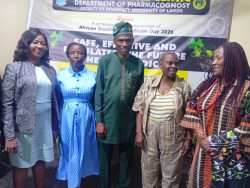
Experts at the University of Lagos (UNILAG) and the National Agency for Food and Drug Administration and Control (NAFDAC) have called for greater scientific evidence, quality assurance and stronger regulation of herbal medicines.
They also warned Nigerians against the assumption that products derived from natural sources are automatically safe, saying natural does not mean safe.
The experts spoke at the 2026 African Traditional Medicine Day symposium, organised by the Model Herbal Clinic, Department of Pharmacognosy, Faculty of Pharmacy, University of Lagos, and held on 3 September at the Old Great Hall, College of Medicine, Idi-Araba. The theme of the symposium was “Safe, Effective and Regulated: The Future of Herbal Medicine”.
The first speaker at the event, Chief Dr (Mrs) Stella Olagbende-Dada, a former lecturer in the Department of Pharmacognosy, UNILAG, said the future of African traditional medicine depended largely on the ability of researchers and practitioners to demonstrate that herbal products were safe, effective and of good quality.
According to her, African Traditional Medicine Day, established by the World Health Organisation (WHO), is observed annually to promote the integration of safe, efficacious and accessible traditional medicine into national healthcare systems across Africa.
“The position of the WHO on herbal medicine is to use what is proven to be safe, effective and of good quality,” she said.
Olagbende-Dada noted that although many medicinal plants had been used for generations, traditional use alone could not be regarded as conclusive evidence of therapeutic effectiveness. She said many herbal preparations were considered effective simply because users reported feeling better after taking them, without the products having undergone the scientific procedures required to establish their actual efficacy.
“Some of our medicinal plants are traditionally used. Because we have used them and feel well, we believe that they are effective, but they are not actually proven to be effective,” she said.
The former UNILAG lecturer therefore called for more scientific investigations, particularly randomised controlled trials (RCTs), to establish the safety and effectiveness of medicinal plants.
According to her, RCTs are important because they help move herbal medicine from subjective claims to scientifically demonstrated therapeutic benefits.
“WHO usually insists that the RCT, that is, the Random Control Trial, is carried out to establish and confirm that these plants or whatever we are using is effective,” she said.
The pharmacy expert added that traditional medicines that have undergone proper scientific validation could make an important contribution to healthcare delivery, particularly in rural areas where access to conventional medicines and healthcare facilities remained limited.
“Traditional medicines of proven quality, safety and efficacy contribute to the goal of ensuring that all people have access to healthcare,” she said.
Also speaking at the event, the second speaker, a Deputy Director, Herbal and Nutraceutical Division, Drug Evaluation and Research Directorate, NAFDAC, Pharm (Mrs) Ijeoma Ezeaka, warned that natural origin should never be used as a substitute for safety assessment, saying, “natural does not equal to risk-free”.
She explained that herbal medicines could be exposed to several safety risks from the point of cultivation and harvesting through processing, manufacturing and storage. According to her, contamination, wrong identification of plants, variations in chemical composition, inaccurate dosage and concentration, toxicity, and interactions with conventional medicines were among the issues that required attention.
She stressed that safety should be determined through scientific evidence and effective controls rather than assumptions about the natural origin of a product. She therefore urged manufacturers to conduct safety studies before applying for registration.
“Before you submit your application for registration, make sure that you carry out a safety test or a safety study on your product,” Ezeaka said.
Another concern raised by the NAFDAC official was the possibility of herb-drug interactions, particularly as some patients combine herbal products with conventional medicines.
“These are things that one needs to be aware of. People might be on herbal medicine and other medicine at the same time. And there can be interactions,” she said.
Ezeaka also identified clinical investigation as a major gap in the development of herbal medicines in Nigeria, stressing that perceived effectiveness was different from demonstrable clinical effectiveness.
She said, “Clinical investigation is very important. That is the area where we are actually lacking in herbal manufacturing.”
She explained that NAFDAC’s regulatory process is designed to ensure that herbal medicines reaching the market meet appropriate standards, noting that manufacturers are expected to undergo documentation, evaluation, manufacturing controls, laboratory controls, facility inspection, marketing authorisation and post-market surveillance.
The NAFDAC official also emphasised the importance of hygienic production and compliance with Good Manufacturing Practice, stressing that manufacturers who could not afford to establish their own facilities should use compliant contract manufacturing arrangements rather than produce herbal medicines in unsuitable environments.
Earlier in his welcome address, the Dean, Faculty of Pharmacy, UNILAG, Prof. Sunday Adesegun, said the theme of the symposium was consistent with the WHO’s emphasis on research and development and the contribution of traditional medicine to universal health coverage in Africa.
Adesegun said the fact that herbal medicine has been part of African healthcare for generations did not remove the need for scientific validation.
He said, “While herbal medicine has been an integral part of African healthcare for generations, its future must be driven by scientific validation, quality assurance, standardisation and effective regulation.”
The Acting Head, Department of Pharmacognosy, UNILAG, Dr Ifeoma Orabueze, said the department is strategically positioned to connect Africa’s traditional medicinal knowledge with modern pharmaceutical science.
Orabueze said the department is committed to research, training and partnerships aimed at transforming indigenous medicinal knowledge into standardised products supported by scientific evidence.
“We are committed to research, training and partnership that will transform raw herbal knowledge into standardised, evidence-based herbal medicine that the world can show,” she said.
She also called on traditional medicine practitioners, researchers and other stakeholders to work together to document, validate and protect indigenous medicinal knowledge.
She urged regulatory agencies and policymakers to develop frameworks that would protect consumers while allowing innovation in the sector to flourish.
“Let us build a framework that protects the customer without creating a limitation,” Orabueze said.
The call for evidence-based herbal medicine reflects the philosophy behind the Model Herbal Clinic, which was established in 2011 through the initiative of Prof. Olukemi Odukoya, with support from other members of the Department of Pharmacognosy.
According to the chairperson of the clinic, Dr Aminat Oyawaluja, the clinic was conceived as a pioneering initiative to bridge African traditional medicine and modern scientific research, with a vision of moving medicinal-plant discoveries from “Bench to Market”.
Over the years, the clinic has developed and demonstrated herbal products in convenient dosage forms, including herbal teas and capsules, while serving as a platform for pharmaceutical education, research, innovation and public engagement.