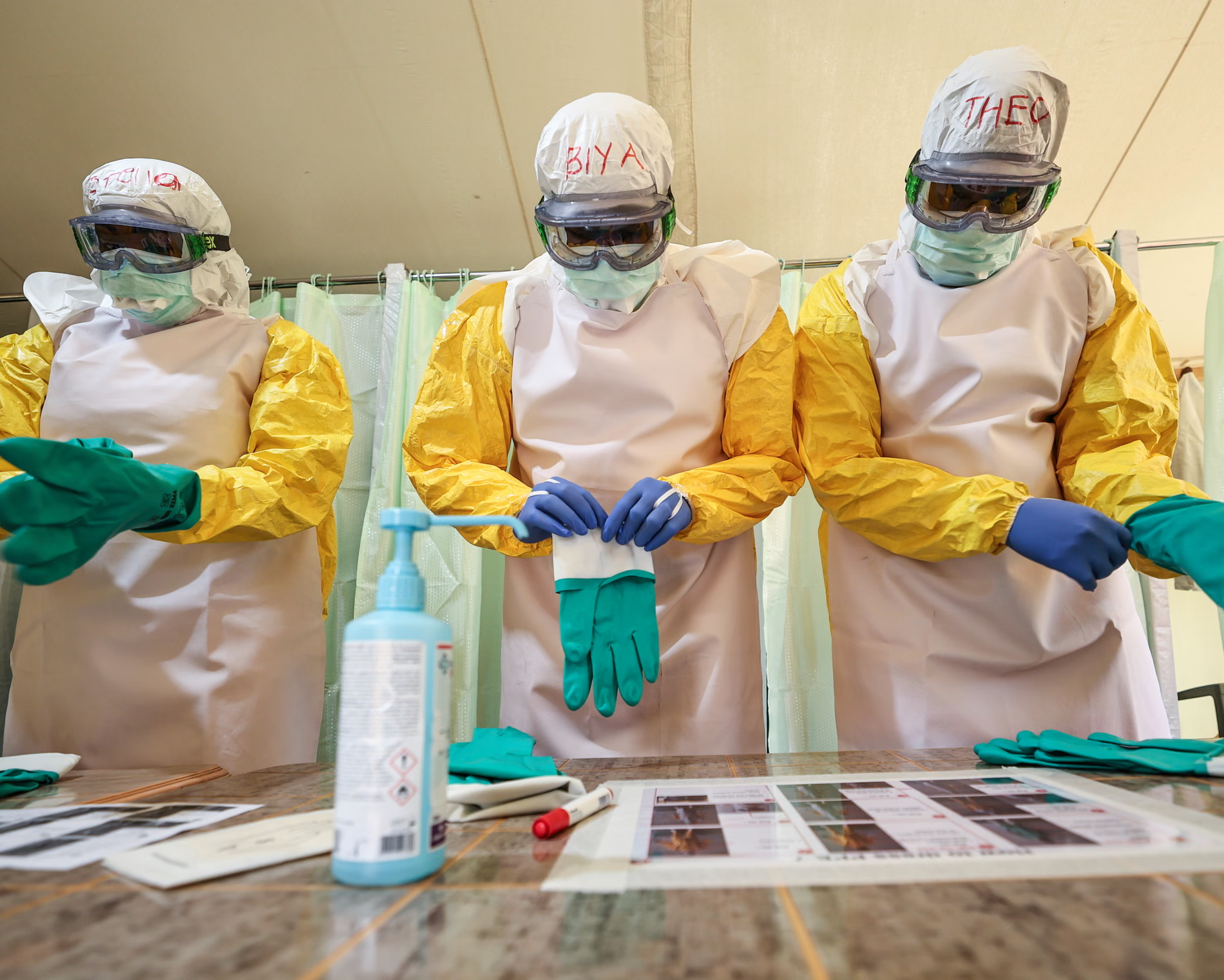
Kenya has confirmed its first case of Ebola after a patient who travelled from the Democratic Republic of Congo (DRC) died in Nairobi.
The confirmation was announced on Tuesday by Kenya’s Cabinet Secretary for Health, Aden Duale, who said the patient tested positive for the Ebola Bundibugyo virus disease (BDBV).
According to Duale, the patient, a Kenyan citizen who had lived in the DRC for about seven years, became ill while in the country and received treatment at several health facilities before travelling to Uganda.
He later travelled by road from the DRC to Kampala, Uganda, before flying to Nairobi on 3 October, on Jambojet flight 8523.
Duale disclosed that the patient underwent routine public health screening upon arrival at the Jomo Kenyatta International Airport but was later taken to Nairobi Hospital by a relative and a friend after his condition worsened.
The patient reportedly presented with symptoms including fever, severe fatigue, weakness, muscle pain, painful swallowing, sore throat and bleeding under the skin around an injection site.
Health workers suspected a viral haemorrhagic fever and collected samples from the patient for laboratory testing.
“The doctors considered his case as that of a viral haemorrhagic fever and collected samples which turned positive for Ebola,” Duale said.
The patient was subsequently isolated and placed on supportive treatment but died at about 11:30 p.m. on Monday.
Following the confirmation, Kenyan health authorities began contact tracing and other response measures to prevent further transmission of the disease.
Duale said 28 contacts had so far been identified, while health officials were also tracing 23 passengers and four crew members who were on the flight with the patient.
The government also said it would conduct a safe and dignified burial in line with public health protocols for Ebola cases.
The confirmation comes as health authorities in the region continue to monitor the Ebola situation in the DRC, where the patient had reportedly spent several years before returning to Kenya.
Kenyan authorities have urged members of the public to remain calm and cooperate with health officials as surveillance and contact-tracing activities continue.